Your AI Dissertation Review Committee
11 specialized AI agents analyze your dissertation across every dimension — methodology, literature, argumentation, writing, and more. Get structured, multi-agent feedback in minutes.
For dissertation proposals, chapter drafts, and pre-defense review. A support tool to complement — not replace — your advisor and committee.
3 free analyses — no credit card required

Ready to see what your committee will find?
Enter your email to create a free account — get 3 analyses, no credit card required.
How It Works
From upload to actionable insights in three simple steps.
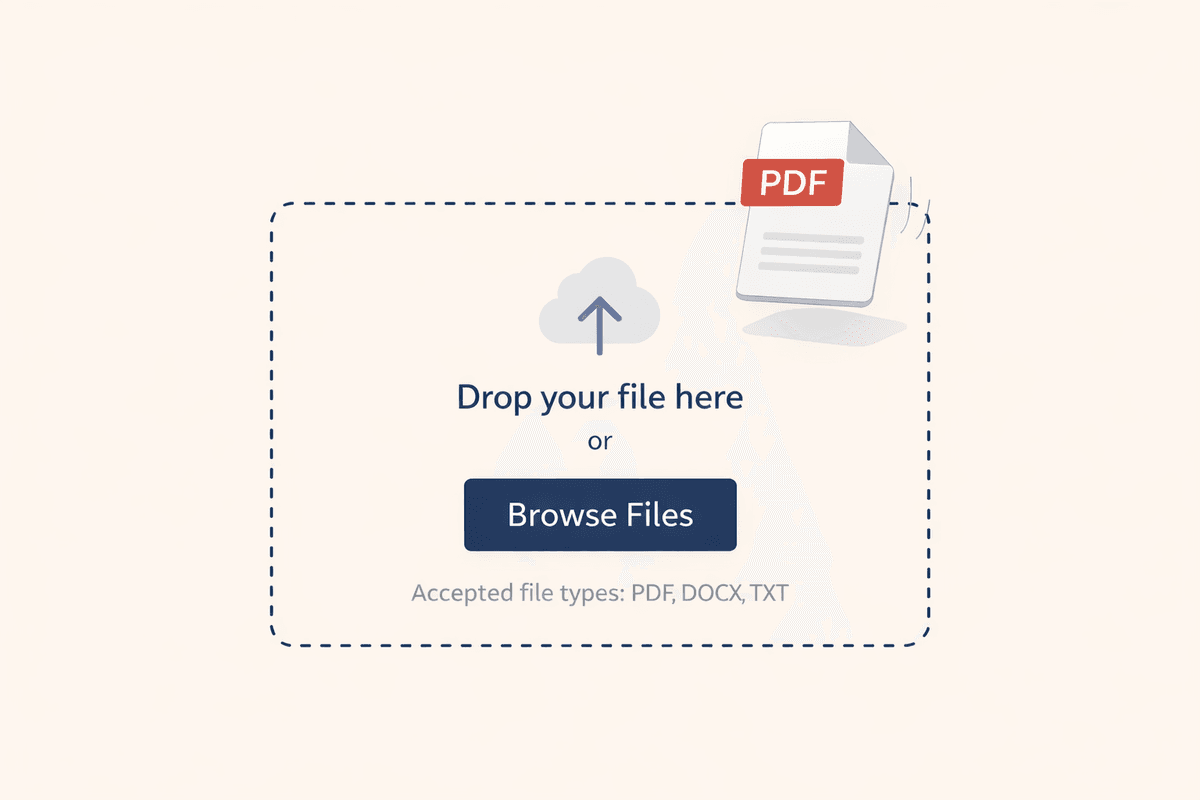
Upload Your Document
Drag and drop your PDF, DOCX, or TXT file. Works with full dissertations, individual chapters, or proposals. Select which sections you want analyzed.
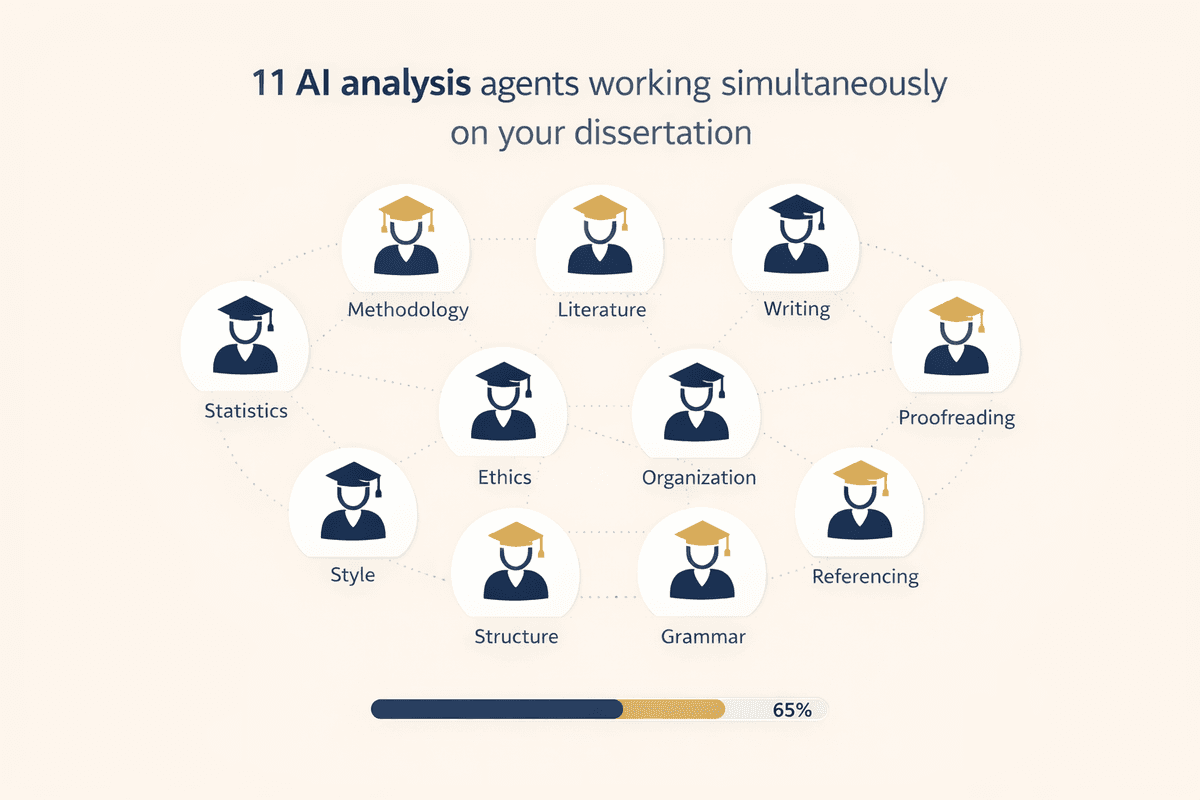
11 AI Agents Analyze
Specialized agents review methodology, literature, argumentation, statistics, and writing quality simultaneously. Watch progress in real time as each agent completes its review.
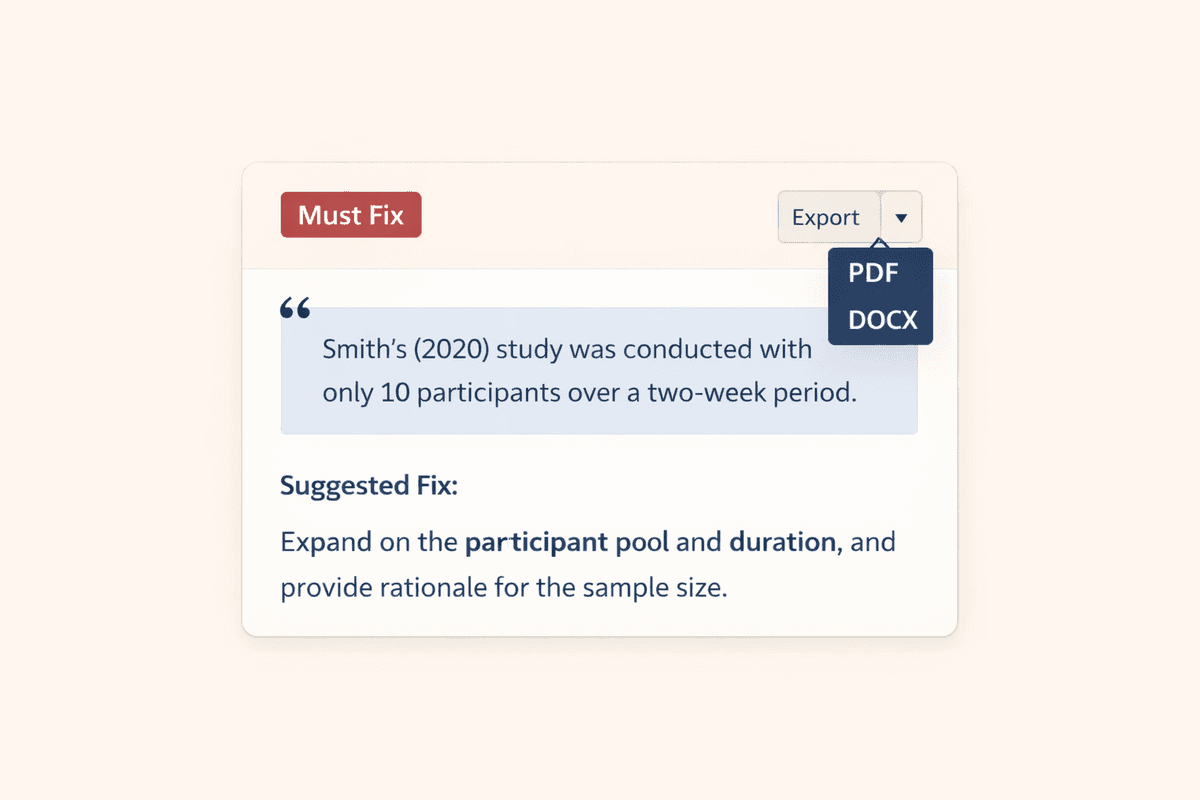
Get Actionable Feedback
Receive severity-rated issues, specific quotes, suggested fixes, and an interactive action plan. Export your results or ask follow-up questions via AI chat.
From Proposal to Defense
Whether you're drafting your prospectus or preparing for your final defense, DissertationAI provides structured feedback at every stage.
Get structured feedback on your dissertation proposal before submitting to your committee. Identify methodology gaps, strengthen your theoretical framework, and ensure your research design is defensible.
Upload individual chapters as you write them. Receive targeted feedback on literature coverage, argumentation logic, and writing clarity — without waiting for your next advisor meeting.
Run a comprehensive analysis before your defense. Simulate committee questions from your actual members, identify weak points, and prepare responses for likely challenges.
Upload revised versions to see exactly what improved between drafts. Track your quality score over time and verify that previous issues have been addressed.
Every Dimension, Covered
Each agent brings specialized expertise, providing a structured multi-perspective review aligned to doctoral evaluation criteria.
Each agent focuses on a different dimension of doctoral writing — methodology, literature, argumentation, statistics, APA compliance, and more.
Get structured feedback in under 15 minutes instead of waiting weeks between advisor meetings. Iterate faster on your own schedule.
Every issue comes with severity ratings, specific quotes from your text, suggested fixes, and academic references. Export to PDF, DOCX, or Markdown.
Evaluates APA 7th edition compliance, statistical methodology, theoretical grounding, and contribution significance — aligned to doctoral evaluation standards.
Identifies gaps in your literature review with specific suggestions for seminal works and recent publications to strengthen your foundation.
Simulate committee questions based on your actual committee members' expertise and research interests. Get predicted questions ranked by likelihood with suggested responses.
See Your Results in Detail
Every analysis produces a structured report with severity-rated issues, chapter-by-chapter breakdown, and an overall quality score.
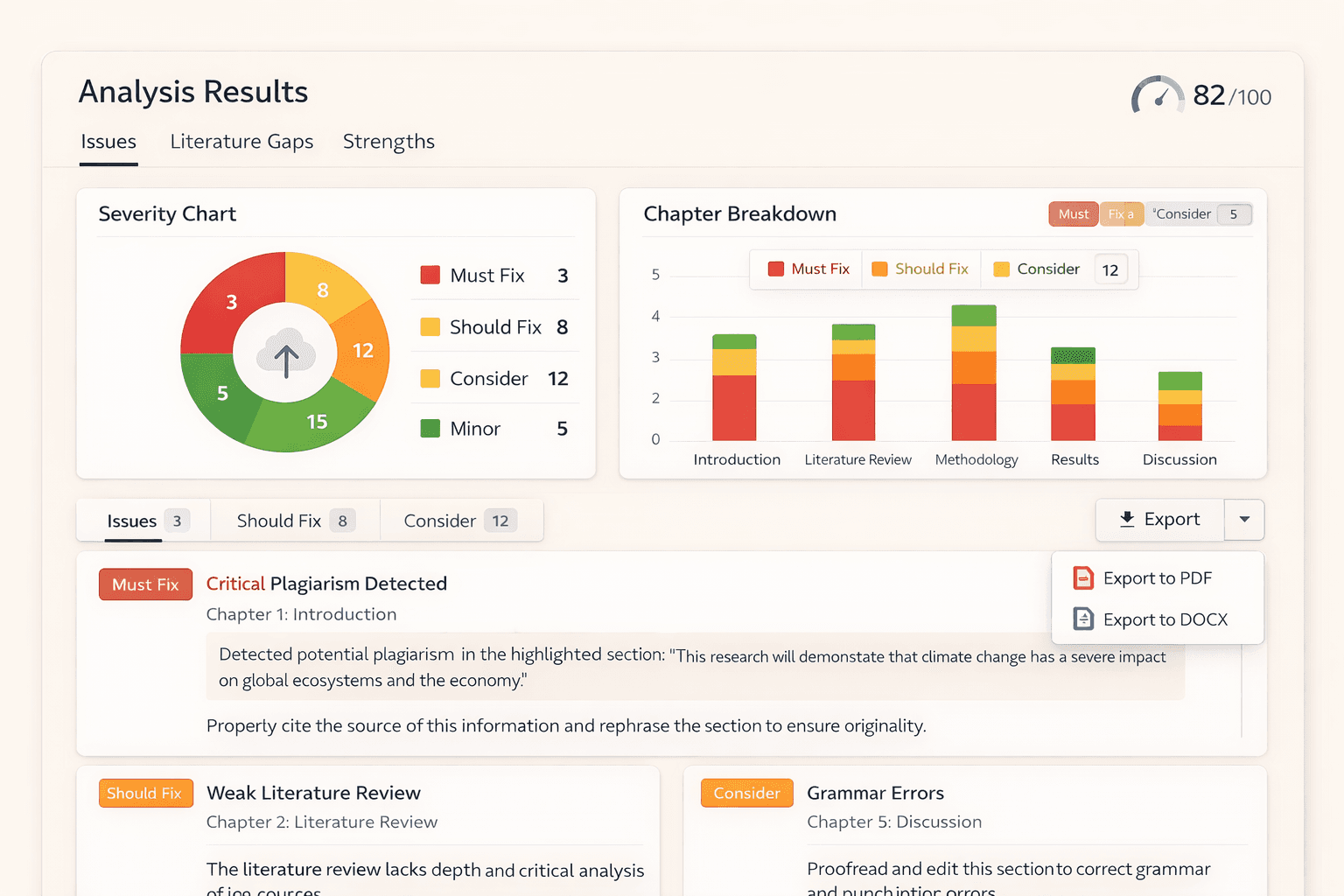
How We Evaluate Your Work
Our analysis is structured around the core dimensions that doctoral committees evaluate. Each dimension is scored and assessed independently.
Methodology & Design
Research design validity, sampling, data collection, and procedural rigor.
Literature & Theory
Coverage of seminal works, theoretical framework coherence, and gap identification.
Argumentation & Logic
Logical flow, claim support, warrant strength, and internal consistency.
Writing & Clarity
Academic tone, paragraph structure, transitions, and readability.
Statistical Methods
Appropriate test selection, assumption checks, effect sizes, and reporting standards.
APA & Compliance
APA 7th edition formatting, citation accuracy, and style consistency.
Contribution & Significance
Originality of contribution, practical implications, and scholarly impact.
What Your Analysis Looks Like
Every finding includes the specific issue, a quote from your text, and a concrete suggestion for improvement.
Cross-sectional design insufficient for causal claims
Chapter 3 makes directional causal claims ("social media use leads to decreased well-being") but uses a cross-sectional survey design that cannot establish temporal ordering.
Reframe as correlational findings or add a longitudinal component to support causal inference.
Missing key theoretical framework
The literature review discusses technology adoption broadly but omits Uses and Gratifications Theory (Katz, Blumler & Gurevitch, 1973), which directly addresses why individuals choose specific media.
Integrate U&G Theory as a complementary lens to your existing TAM framework in Section 2.3.
"How do you account for self-selection bias in your sample?"
Predicted from Dr. Martinez (Methods) — your convenience sampling of university students limits generalizability. Committee members with quantitative expertise frequently probe sampling decisions.
Prepare a response addressing Heckman correction or propensity score matching as post-hoc adjustments.
Unsupported warrant in discussion section
The claim that "these findings have direct implications for clinical practice" (p. 94) is not warranted by the study's non-clinical sample and correlational design.
Qualify the claim: "These findings suggest areas for future clinical investigation" rather than asserting direct clinical implications.
Plans for Every Stage of Your Journey
Start free. Upgrade when you need more power.
Need institutional pricing for your university? Contact us
Confidentiality & Data Handling
Your dissertation is your intellectual property. We handle it accordingly.
Your Work Stays Yours
Your dissertation text and analysis results belong to you. We do not claim any rights to your content.
Secure Processing
Files are transmitted over encrypted connections and processed in isolated environments.
Not Used for AI Training
Your documents are never used to train or fine-tune AI models. Your research stays private.
You Control Deletion
Delete your analyses and uploaded documents at any time. When you delete, we delete.
What Doctoral Students Are Saying
“DissertationAI caught methodology gaps my advisor missed. The committee simulation feature predicted 3 of the 5 questions I was asked at my defense.”
Sarah M.
PhD Candidate, Educational Psychology
“I was stuck on my literature review for months. The AI agents identified exactly which seminal works I was missing and how to integrate them into my framework.”
James K.
Doctoral Researcher, Public Health
“Getting structured feedback in 15 minutes instead of waiting 3 weeks for my advisor changed everything. I finished my dissertation a full semester early.”
Maria L.
PhD Graduate, Organizational Leadership